Hi! I'm Hayley Hutson
I’m a freelance writer based in Charlotte, North Carolina. I have a passion for helping small businesses thrive, and a knack for doing so by creating content that resonates with their audience.
Let's Bring Your Vision to Life! Get in touch

As a content strategist, I see so many businesses and entrepreneurs make the mistake of posting whatever comes to mind. Sure, it may help you fill a page, but that approach won’t help you achieve long-term growth. That’s why you need content pillars to carve the path forward.
Content pillars are the foundation of your blog. They’re the core topics your brand is known for and the guiding framework that keeps your content focused and easy to follow.
In this guide, I’ll walk you through how to use content pillars to organize your blog for long-term SEO growth and audience loyalty. Let’s transform your content marketing strategy.
Imagine walking into a store where the products are scattered everywhere: no aisles, no categories, no logic. You’d probably get overwhelmed and walk right out, like I have in some of the more chaotic thrift stores I’ve visited.
That’s exactly how your blog feels to readers (and Google) when it doesn’t have structure.
Content pillars are your blog’s “aisles.” They’re the main themes your content revolves around—the topics you want to be known for and the areas where you can consistently provide value. Here’s why they matter:
When you use content pillars for SEO, you’re basically telling Google, “Hey, I’m an expert in this area. Here’s a library of high-quality posts to prove it.”
So you know content pillars are important, now it’s time to put them to work for your blog. This process will help you go from scattered topics to a clear, organized content marketing framework that supports your SEO goals and builds authority in your niche over time.
Whether you’re starting from scratch or refining an existing blog, these steps will give you a structure you can stick with for the long haul.
Quick Steps:
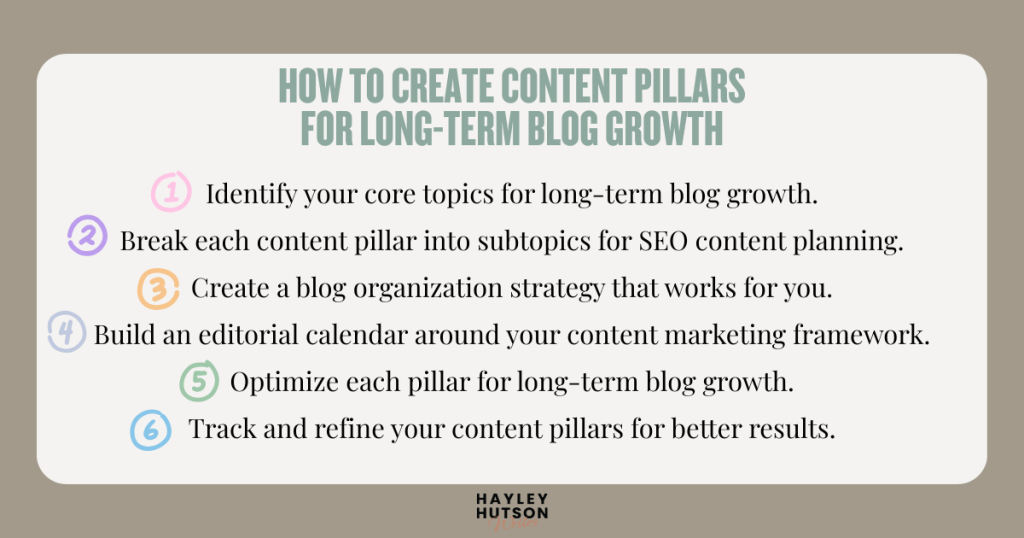
Before you can start building your pillars, you need to know what your big 3-5 topics will be. These should hit the sweet spot between what your audience cares about and what your business offers.
Here’s how to figure them out:
Example: If you’re a health and wellness coach, your content pillars might be Nutrition Tips for Busy Professionals, Simple Home Workouts, and Mindset & Stress Management Strategies.
The goal is to strategically choose pillars you can stick with for the long haul. They’ll guide your content calendar and help you stay consistent month after month.
Once you’ve chosen your pillars, it’s time to break them down into subtopics. This will help you build the framework that will guide the blog posts or social media content that will live under each category.
This is where SEO content planning really kicks in:
By organizing your blog this way, you’re creating a network of related posts that support each other in search rankings. Google loves this kind of internal linking because it shows you have depth and authority on the topic.
Now, it’s time to set up your blog so it’s easy to navigate for readers and easy to crawl for search engines. Here are some tips for a solid blog organization plan:
Think of your content pillars as the big picture and your internal linking strategy as the threads that connect the details.
Your content pillars will make creating an editorial calendar so much easier. Instead of wondering what to post each week, you’ll rotate through your pillars to keep things balanced and consistent.
For example:
By spreading your posts evenly across pillars, you’ll:
Bonus tip: if you’re ever stuck for ideas, just look back at your pillars and brainstorm another subtopic. ChatGPT can be a great tool for brainstorming, so try sharing your content pillars and asking for additional subtopic ideas.
If you want your content pillars to drive real business results, they need to be optimized for both humans and search engines. That means:
When your pillars are fully optimized, they’ll keep working for you long after you hit publish. That’s the beauty of long-term blog growth.
Like any good strategy, your content pillar framework isn’t set in stone. Over time, some pillars may perform better than others, and you might discover new topics your audience is obsessed with.
Use tools like Google Analytics and Search Console to:
Then, adjust your pillars and subtopics based on real data—not just gut instinct.
Organizing your blog or social media platforms with content pillars is a long-term growth strategy. It keeps your content focused, helps you rank for the topics that matter, and makes your blog infinitely easier to navigate.
The key is to choose pillars that align with your expertise and your audience’s needs, then commit to building them out. Over time, you’ll create a library of content that works harmoniously to position you as the go-to authority in your space.
Not sure where to start? I can help. From keyword research to blog organization, I’ll create a content pillar strategy that makes your content work harder for your business. Get in touch with me today and let’s turn your content marketing plan into a well-oiled machine.
I’m a freelance writer based in Charlotte, North Carolina. I have a passion for helping small businesses thrive, and a knack for doing so by creating content that resonates with their audience.